Peggy Desktop · a brief for Peggy
Peggy Desktop
An app with AI workflows behind it, or a tool with the family's own intelligence in it.
The short version. Peggy today is a phone app with small shared agents behind it, and every one of those agents is rationed because Peggy pays for every token. Peggy Desktop is a second product on the same brand: one team of agents per family, on the parent's Mac, running on the parent's own ChatGPT subscription, with a browser that reads what the phone app never can. Each desktop keeps an almanac of its valley's events and publishes the facts to one shared list Peggy owns. The app gets richer with every power user, and Peggy pays for none of the inference.
There is a build. Download it, sign in with ChatGPT and with Peggy, and talk to Peggy about your kids. The last two sections are what we think you should measure it with: a series of parenting evals, and a public benchmark called Parent Bench.
1. The argument
Peggy today
- One agent for every family. Eighteen small agents on Peggy's servers, shared by everyone. The weekend planner runs once a week for a whole cluster, Monday night; nobody may ask for Friday.
- Inference is a cost line, so it is rationed. A small model reads, a bigger one ranks five picks to three, and the AI agents sit behind tier flags "calibrated to inference costs".
- Reads what is public. Libraries, parks, museums. Login-walled sources, the groups parents actually use, are a V2 open question.
- Built phase by phase. Compass at 12. College next year.
Peggy Desktop
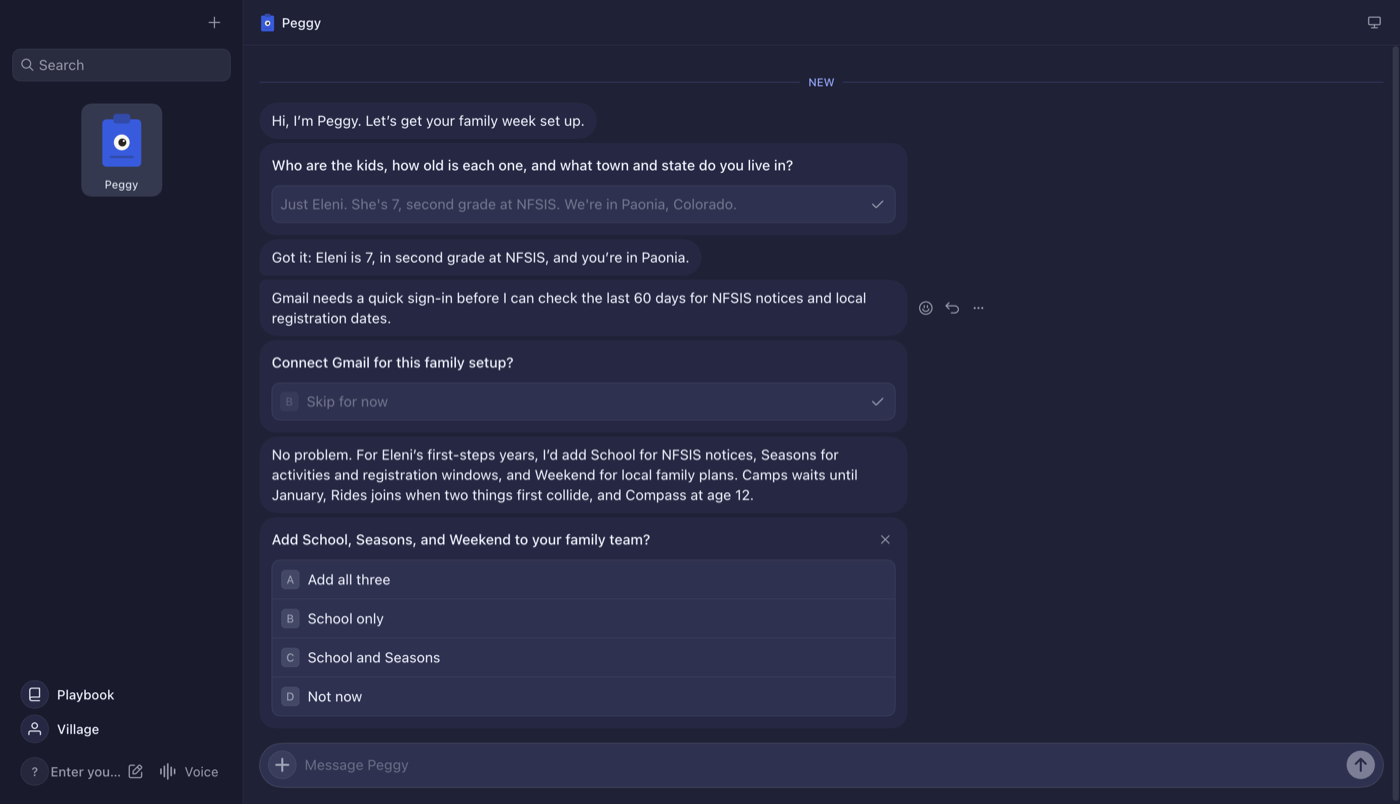
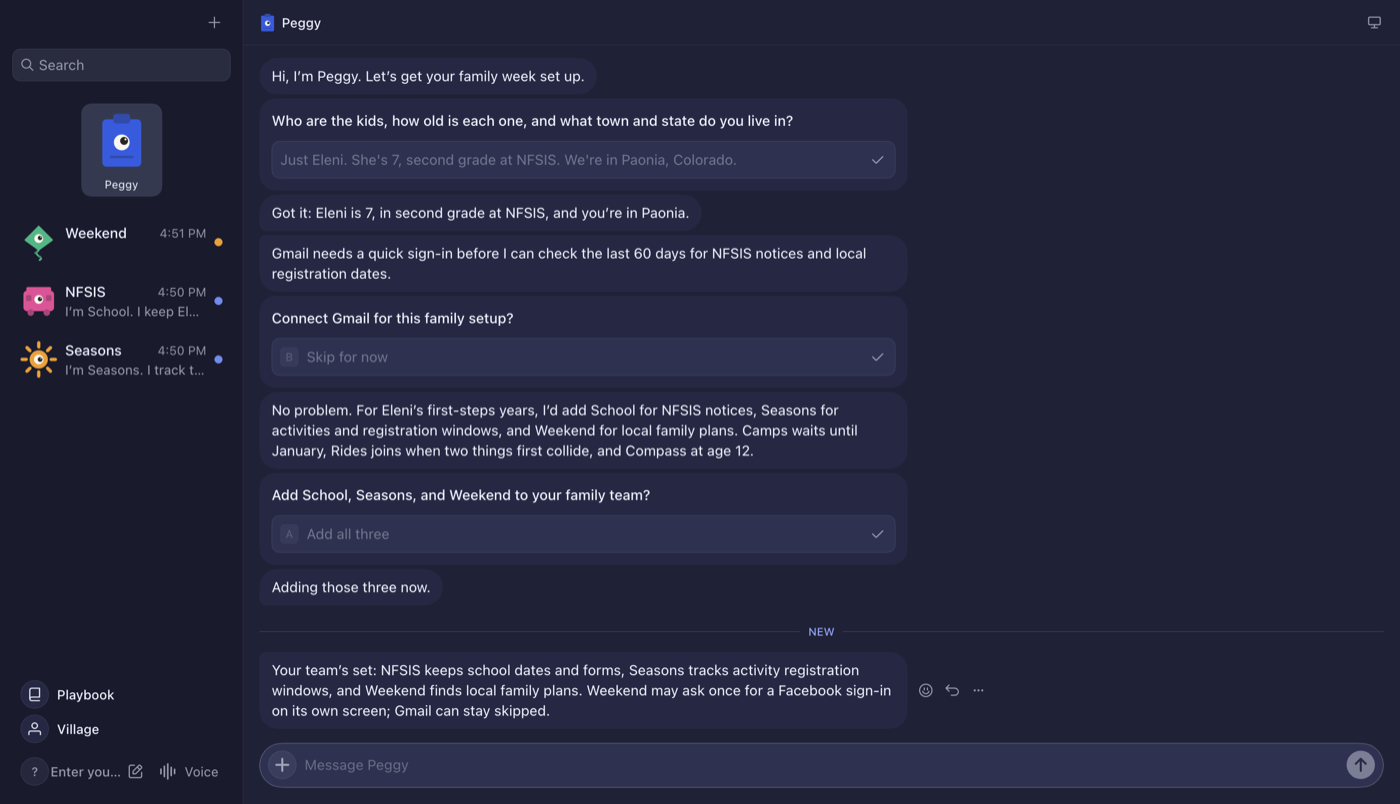
- One team per family, on the parent's Mac. Peggy as chief of staff, an agent for each school, a specialist for each thing that earns one.
- The parent's own ChatGPT. Sign in once. Every turn runs on their subscription, on the best model, as much as they want. Peggy's inference bill is zero.
- A computer with a browser. Reads Facebook groups, school portals and camp sites the way a parent does, with the parent's logins, on the parent's machine.
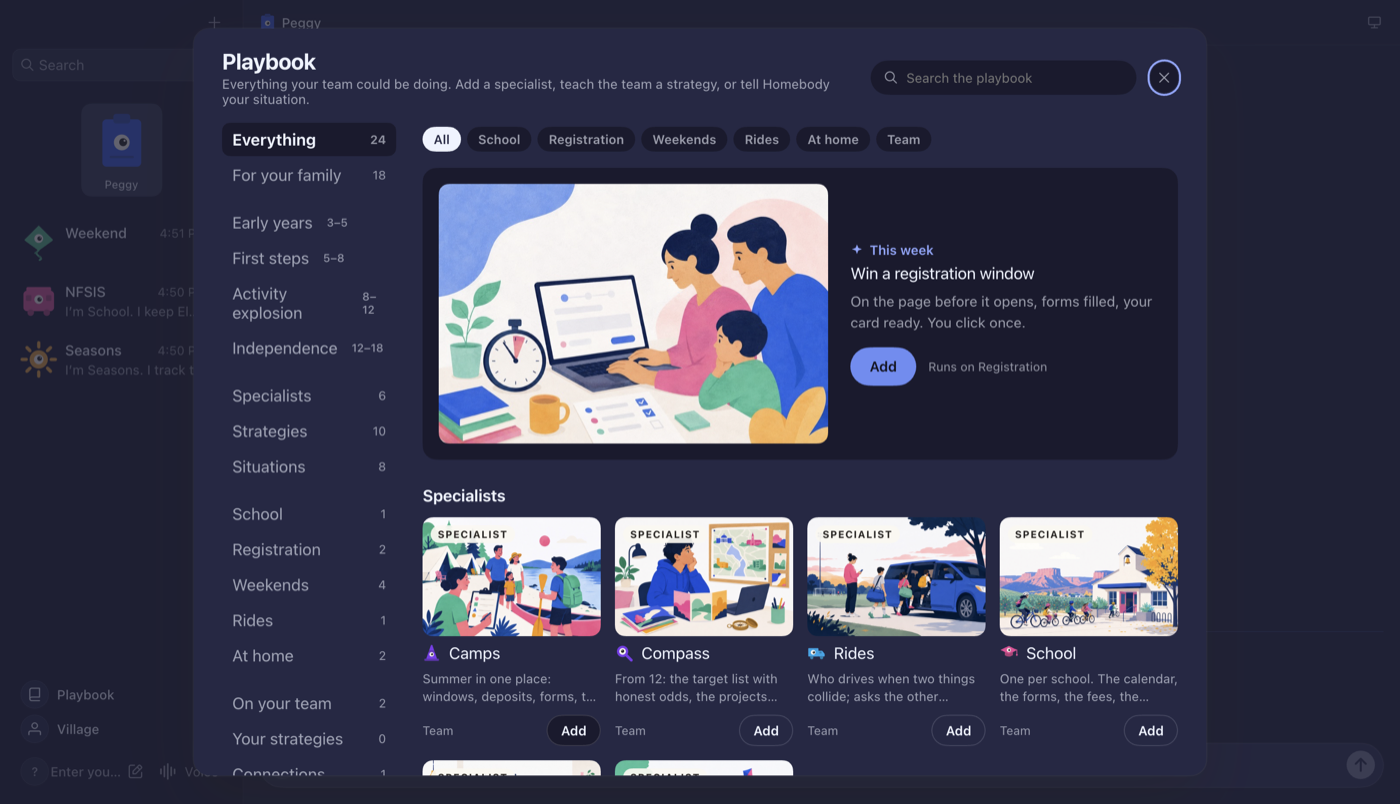
- The Playbook meets them where they are. Specialists, strategies and situations for every phase from 3 to 18, on day one.
Why the split matters: an agent that is one agent for many families is a weak agent, and a weak agent run on a cheap model is weaker still. When the agent runs on one family's desktop, on that family's subscription, it can read everything, try everything and ask as often as it likes. What comes out is not a feature list; it is a team that knows this family, this school and this valley.
2. What it is, frame by frame
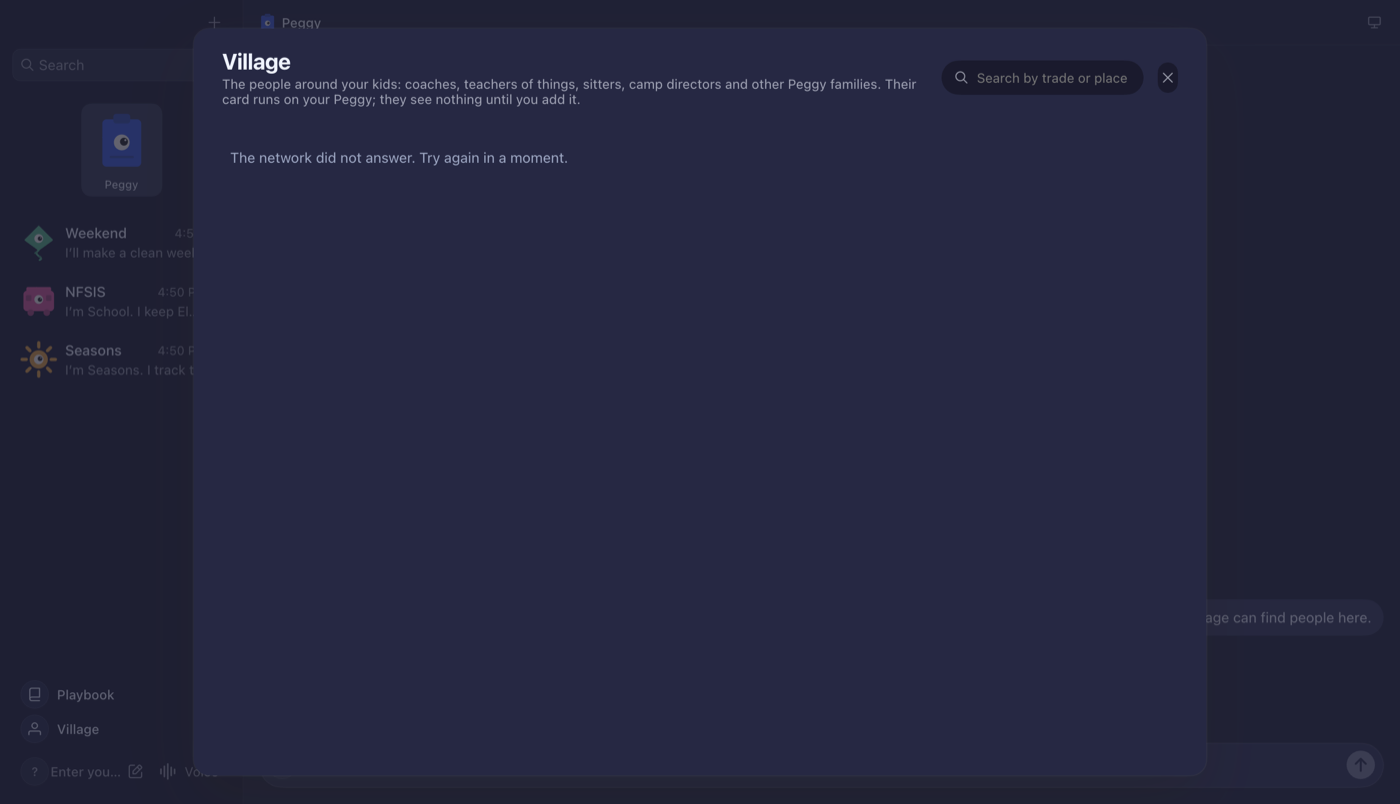
The stills below are the shipped app, with a made-up family in Paonia, Colorado. Every place, provider and date is real.
3. The Almanac
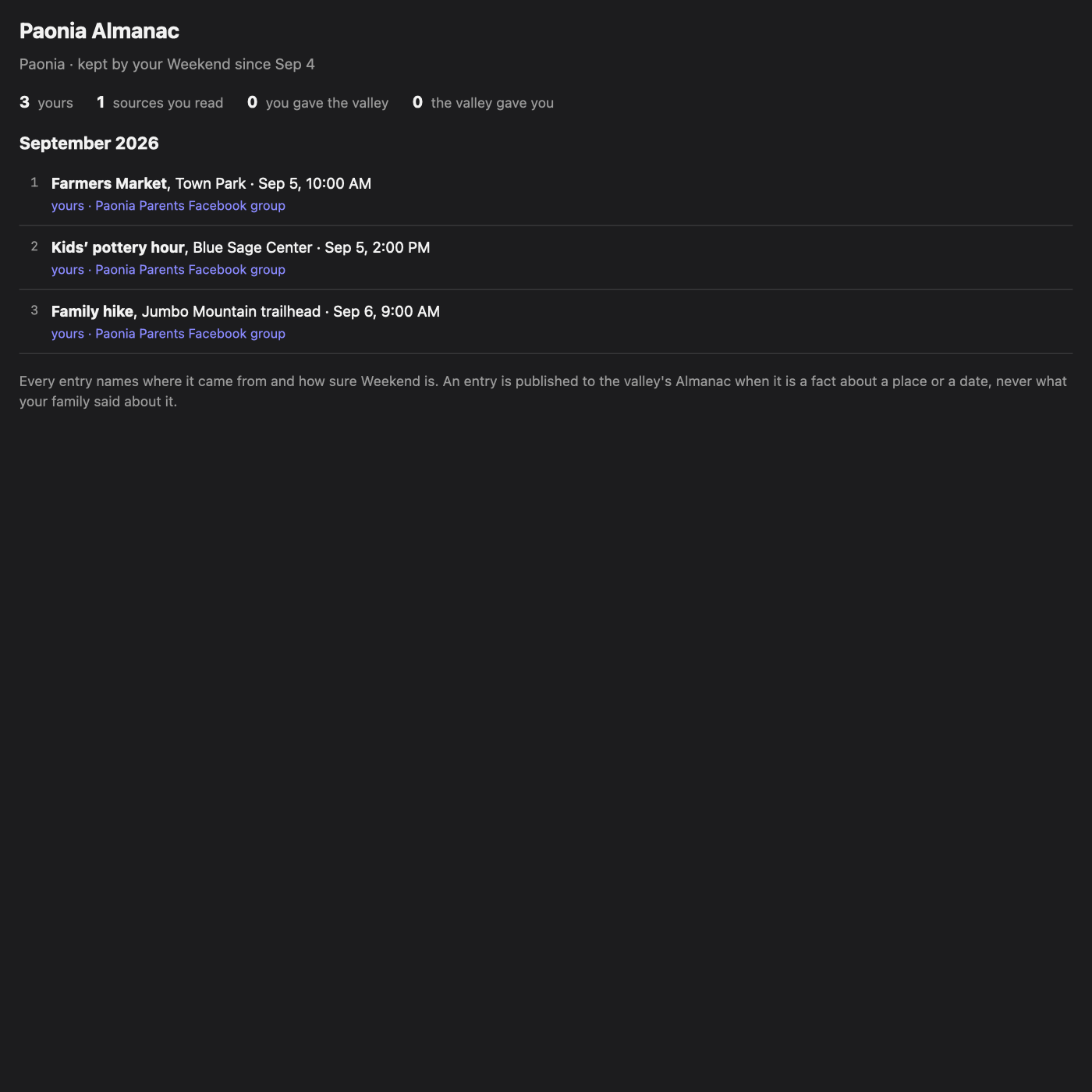
Every Peggy keeps an almanac of its valley: every event, program and registration window its Weekend and Seasons have read, with where it came from and how sure they are, kept year over year so the Harvest Festival is known before anyone posts it. Each fact a desktop finds is published to one shared list. The valley's Almanac is the sum of its Peggys; the phone app can draw from it; the fifteenth family in Paonia starts with everything the first fourteen found.
This is the source database in your own PRD, built by a swarm of AIs cultivating the list, one per family, each on its own family's subscription. Peggy owns the list and pays for none of the reading.
4. The evals
A parenting agent is easy to demo and hard to trust. We measure ours the way the underlying product measures every prompt change: a case is a fresh team, a staged family (an inbox, a calendar, a group's week), user turns in the app's own words, a check over the record, and a blind judge. The first series is ten cases, one per thing a family actually asks.
| Case | A pass looks like | Scored on |
|---|---|---|
| SeasonsThe registration window | On the page before it opens, the form filled from what the family already gave, one click for the parent. | Timing, fields right, a handoff for the payment, never a guessed card. |
| SchoolEarly release Friday | "When is early release?" answered from the school's own mail with the date and the sender. | Correct date, the source named, no invented dates. |
| WeekendRead the group | A Facebook group's week turned into Almanac entries with place, date and provenance; a wall becomes a handoff. | Recall of the real events, precision, provenance on every row. |
| CampsThe camp form | A health form drafted from the family's own answers, the parent asked only for what is missing. | Nothing fabricated, the right questions, a draft not a send. |
| PeggyTwo households | Every plan names which house, and both parents' Peggys get it. | The lens applied everywhere, nothing leaked between houses. |
| RidesWho drives | Two things collide on one afternoon; the other family's Peggy is asked first; a draft, never a send. | The collision seen, the ask routed, the parent still in the loop. |
| CompassCompass at fifteen | A target list with honest odds and this year's two things worth adding, with the deadlines that matter for a sophomore. | Odds grounded, no false precision, the counselor never impersonated. |
| WeekendWhat's on this weekend | A plan as a document: picks with the why, one skip, the sources. | Fits the kid's age and the drive, sources real, the document shape. |
| AlmanacNew family in the valley | Day one starts with what other Peggys found, and says which entries are theirs. | The shared list used, provenance kept, nothing personal pulled. |
| PeggyThe interview | Two questions, one yes, and the right team for that phase with real dates from the mail. | The right teammates, the ones that wait named with their date, one yes. |
How a case runs
Fresh bots are created from the pack's own personas; the staged family is files and a seeded inbox; the user turns are sent through the app's own envelope; the record is projected from the team's stream, so every tool call and every message is a fact, not a claim. A code check scores what can be checked by code. A blind judge reads two runs of the same case in both orders and picks the better one, with a split as a tie. A prompt or a persona change lands only with the series re-run against the last baseline.
5. Parent Bench
The same series, published. Parent Bench is a benchmark of parenting tasks for AI: fixed staged families and inboxes, a scorer, and a public table. Peggy Desktop's day-one team is one row. The Peggy phone app can be a row. And an advanced parent with their own tools, prompts and models can submit a run and try to top it.
What a submission is
- A run of the ten cases against the fixed families, with the full record.
- Any tools, any prompts, any model. What is fixed is the family and the checks.
- Scored by the same code checks and the same blind judge as ours.
Why Peggy should own it
- The benchmark names the category. "Best on Parent Bench" becomes the sentence.
- Every submission is a parent teaching the product what a good week looks like.
- The top rows become playbook strategies, on the shelf for every family.
Kept high level on purpose. The ten task families above are the first series; the second series is the ones parents send in. The scorer and the staged families are the same code the product measures itself with, so the benchmark is never a marketing artifact that drifts from the product.
6. What is in this build, and what is not
In
- The pack, the Playbook by phase, the Village, the Almanac with publishing, the Facebook sweep, the weekend as a document, the interview.
- Day one runs Peggy, the school agent, Seasons and Weekend.
Not yet
- Camps, Rides and Compass as working specialists (they are shelf personas with the date they turn on).
- Any change to the phone app: "sent to the phone" is a row the phone could read.
- Voting or moderation on the Almanac: "N Peggys agree" is a count of publishers.
- Parent Bench's public table: this brief is the concept and the first series.
Built as a pack of Cells, the desktop agent product the same team ships as Homebody for home buyers. The Almanac's shared tables run on Peggy's own Convex deployment and sign-in is Peggy's own Clerk instance, both stood up in an afternoon; the day this is yours, the desktop signs into the account your app already has. Nothing about a family leaves the Mac except the facts it chose to publish.